Note
Go to the end to download the full example code
Transforming training datasets#
Some optimization workflows need a different set of datapoints during training without changing the interface expected by the pipeline. Data augmentation can multiply datapoints, while a quick smoke test might train on only a small subset. Both operations must happen after a cross-validation fold is split so related augmented data can never leak into the test set.
This example demonstrates both cases using train_dataset_transform. A transform is simply a callable receiving a
dataset and returning a dataset that implements the same interface. The pipeline remains generic over one common
dataset type and can handle original and transformed datapoints identically.
A reusable dataset wrapper#
DatasetWrapperMixin handles the mechanics shared by datasets that wrap other datasets: it derives the initial
grouping from the wrapped dataset, materializes the expanded index, and resolves the wrapped datapoint represented by
an augmented datapoint.
Important
The inheritance order is essential: DatasetWrapperMixin must be listed before ImageDataset. Python
resolves methods from left to right, so reversing the bases would select the original Dataset.create_index
instead of the implementation supplied by the mixin. TPCP detects the reversed order when the class is defined and
raises a TypeError with an explanation.
class AugmentedImageDataset(
    DatasetWrapperMixin[ImageDataset],
    ImageDataset,
):
    """Dataset wrapping an image dataset and exposing lazily rotated datapoints.

    ``DatasetWrapperMixin`` must remain the first base class so its index implementation takes precedence.
    """

    _wrapper_groupby_cols = ("rotation_deg",)

    def __init__(
        self,
        wrapped_dataset: ImageDataset,
        rotation_degrees: tuple[int, ...] = (0, 90, 180, 270),
        *,
        groupby_cols: Optional[Union[list[str], str]] = None,
        subset_index: Optional[pd.DataFrame] = None,
    ) -> None:
        self.wrapped_dataset = wrapped_dataset
        self.rotation_degrees = rotation_degrees
        super().__init__(groupby_cols=groupby_cols, subset_index=subset_index)

    def _create_wrapped_index(self, source_index: pd.DataFrame) -> pd.DataFrame:
        """Add an augmentation dimension to the wrapped dataset's index."""
        rotation_col = self._wrapper_groupby_cols[0]
        return (
            pd.concat(
                [
                    source_index.assign(**{rotation_col: rotation})
                    for rotation in self.rotation_degrees
                ],
                ignore_index=True,
            )
            .sort_values([*source_index.columns, rotation_col])
            .reset_index(drop=True)
        )

    @property
    def image(self) -> np.ndarray:
        """Proxy the original image and apply the rotation encoded in the index."""
        self.assert_is_single(self.groupby_cols, "image")
        rotation_col = self._wrapper_groupby_cols[0]
        rotation_degrees = int(self.index.iloc[0][rotation_col])
        return np.rot90(
            self.wrapped_datapoint.image, k=rotation_degrees // 90
        ).copy()

    @property
    def label(self) -> int:
        """Proxy the label of the wrapped original datapoint."""
        return self.wrapped_datapoint.label
We use a tiny in-memory image dataset to keep the example fast. The first class contains variants of an L-like shape, while the second contains variants of a T-like shape.
images = np.asarray(
    [
        [[1, 0, 0], [1, 1, 0], [1, 0, 0]],
        [[1, 0, 0], [1, 0, 0], [1, 1, 0]],
        [[1, 1, 0], [1, 0, 0], [1, 0, 0]],
        [[1, 1, 1], [0, 1, 0], [0, 1, 0]],
        [[1, 1, 1], [1, 0, 1], [0, 1, 0]],
        [[0, 1, 0], [1, 1, 1], [0, 1, 0]],
    ],
    dtype=float,
)
labels = np.asarray([0, 0, 0, 1, 1, 1])
raw_dataset = RawImageDataset(images, labels)
Real augmentation: rotate images#
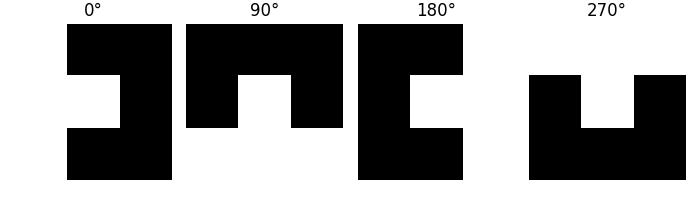
The transform receives only the training subset created for a fold. The augmented dataset stores that subset as its
wrapped_dataset parameter and builds its expanded index from it. Data and reference properties are resolved
through the wrapped subset only when the pipeline accesses an individual datapoint.
def rotate_training_images(dataset: ImageDataset) -> AugmentedImageDataset:
    """Add 90, 180, and 270 degree rotations of every provided datapoint."""
    return AugmentedImageDataset(dataset.clone())


augmented_dataset = rotate_training_images(raw_dataset)
Accessing a rotated datapoint uses exactly the same image and label properties as accessing an original.
rotations = [
    augmented_dataset.get_subset(
        index=pd.DataFrame(
            augmented_dataset.index.loc[
                (augmented_dataset.index["sample_id"] == 0)
                & (augmented_dataset.index["rotation_deg"] == angle)
            ]
        )
    )
    for angle in (0, 90, 180, 270)
]
fig, axes = plt.subplots(1, 4, figsize=(7, 2))
for datapoint, angle, axis in zip(rotations, (0, 90, 180, 270), axes):
    axis.imshow(datapoint.image, cmap="gray", vmin=0, vmax=1)
    axis.set_title(f"{angle}°")
    axis.axis("off")
fig.tight_layout()
A pipeline that handles both dataset classes#
This deliberately small nearest-neighbour classifier stores the images it receives during optimization. Its only
dataset type is ImageDataset; it has no augmentation-specific logic.
from tpcp import OptimizableParameter, OptimizablePipeline


class ImageClassificationPipeline(OptimizablePipeline[ImageDataset]):
    """A minimal nearest-neighbour image classifier."""

    training_images: OptimizableParameter[Optional[np.ndarray]]
    training_labels: OptimizableParameter[Optional[np.ndarray]]

    prediction_: int

    def __init__(
        self,
        training_images: Optional[np.ndarray] = None,
        training_labels: Optional[np.ndarray] = None,
    ) -> None:
        self.training_images = training_images
        self.training_labels = training_labels

    def self_optimize(self, dataset: ImageDataset, **_: object):
        """Remember all provided images as nearest-neighbour training samples."""
        self.training_images = np.stack(
            [datapoint.image for datapoint in dataset]
        )
        self.training_labels = np.asarray(
            [datapoint.label for datapoint in dataset]
        )
        return self

    def run(self, datapoint: ImageDataset):
        """Classify an original or augmented datapoint."""
        if self.training_images is None or self.training_labels is None:
            raise RuntimeError(
                "The pipeline must be optimized before it can classify images."
            )
        distances = np.linalg.norm(
            self.training_images - datapoint.image, axis=(1, 2)
        )
        self.prediction_ = int(self.training_labels[np.argmin(distances)])
        return self


def accuracy(
    pipeline: ImageClassificationPipeline, datapoint: ImageDataset
) -> float:
    """Score one image."""
    return float(pipeline.safe_run(datapoint).prediction_ == datapoint.label)
Fold-local augmentation#
cross_validate first creates the untouched train and test subsets. Optimize then transforms only the train
subset immediately before self_optimize. The scorer therefore continues to evaluate original images.
from sklearn.model_selection import StratifiedKFold
from tpcp.optimize import Optimize
from tpcp.validate import DatasetSplitter, cross_validate

cv = DatasetSplitter(StratifiedKFold(n_splits=3), stratify="label")

augmentation_results = cross_validate(
    Optimize(
        ImageClassificationPipeline(),
        train_dataset_transform=rotate_training_images,
    ),
    raw_dataset,
    scoring=accuracy,
    cv=cv,
    return_optimizer=True,
    progress_bar=False,
)
augmentation_training_sizes = [
    len(optimizer.transformed_dataset_)
    for optimizer in augmentation_results["optimizer"]
]
print(augmentation_training_sizes)
Datapoints:   0%|          | 0/2 [00:00<?, ?it/s]
Datapoints: 100%|██████████| 2/2 [00:00<00:00, 130.18it/s]

Datapoints:   0%|          | 0/2 [00:00<?, ?it/s]
Datapoints: 100%|██████████| 2/2 [00:00<00:00, 132.46it/s]

Datapoints:   0%|          | 0/2 [00:00<?, ?it/s]
Datapoints: 100%|██████████| 2/2 [00:00<00:00, 133.22it/s]
[16, 16, 16]
Subsampling for a smoke test#
A smoke-test transform follows the same interface. Here we keep one training datapoint per class, reducing every fold from four training images to two while leaving its two scored test images untouched.
def subsample_for_smoke_test(dataset: ImageDataset) -> ImageDataset:
    """Keep one datapoint per class for a fast end-to-end check."""
    smoke_test_index = dataset.index.groupby(
        "label", sort=True, as_index=False
    ).head(1)
    return dataset.get_subset(index=smoke_test_index)


smoke_test_results = cross_validate(
    Optimize(
        ImageClassificationPipeline(),
        train_dataset_transform=subsample_for_smoke_test,
    ),
    raw_dataset,
    scoring=accuracy,
    cv=cv,
    return_optimizer=True,
    progress_bar=False,
)
smoke_test_training_sizes = [
    len(optimizer.transformed_dataset_)
    for optimizer in smoke_test_results["optimizer"]
]
print(smoke_test_training_sizes)
Datapoints:   0%|          | 0/2 [00:00<?, ?it/s]
Datapoints: 100%|██████████| 2/2 [00:00<00:00, 129.93it/s]

Datapoints:   0%|          | 0/2 [00:00<?, ?it/s]
Datapoints: 100%|██████████| 2/2 [00:00<00:00, 133.68it/s]

Datapoints:   0%|          | 0/2 [00:00<?, ?it/s]
Datapoints: 100%|██████████| 2/2 [00:00<00:00, 136.11it/s]
[2, 2, 2]
The important distinction is visible in both result sets: the optimizer sees the transformed training dataset, but
test__data_labels and all reported test scores still refer to the original datapoints.
Total running time of the script: (0 minutes 2.127 seconds)
Estimated memory usage: 9 MB